


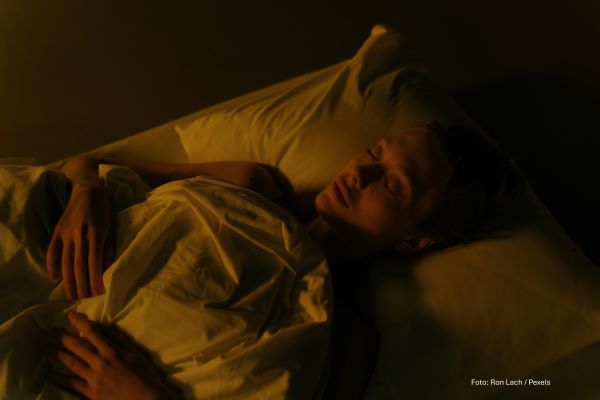
ME/CFS - Myalgic Encephalomyelitis: Sleeping booths isolate against noise and light
A disease full of mystery
Pain, fatigue and sensory hypersensitivity
Tens of millions of people worldwide suffer from myalgic encephalomyelitis, including two million in Europe alone. The number of undiagnosed cases is likely much higher. Almost 50 percent of those affected are so severely affected that they can no longer leave their homes. Many are bedridden.
Severe nerve and joint pain, cognitive impairment, and often extreme exhaustion, fatigue, and intolerance to exertion are just a few of the many symptoms of ME. Sleep disturbances and hypersensitivity to stimuli, especially noise and light, are also common.
Central nervous system malfunctions
Brainwaves are the electrical activity patterns of our brain. They are divided into five main types (measured in Hertz) and control our states of consciousness: from wide awakeness to deep sleep. During sleep, these waves gradually slow down to allow the body the necessary regeneration.
Sleep disorders arise when the natural cycle of brain waves is disrupted, and the central nervous system misregulates the sleep-wake rhythm. The brain is unable to lower its frequencies. Instead of resting in deep sleep (delta waves), the brain remains trapped in a restless, more alert state (e.g., beta or alpha frequencies).
No recovery despite good sleep hygiene
This overactivity leads to ME/CFS patients experiencing only superficial sleep, leaving them feeling exhausted or "as if they've been run through the wringer" the next morning despite many hours of sleep.
Sleep hygiene – all the habits, behaviors and environments that promote healthy, restful sleep and usually prevent difficulty falling asleep and staying asleep – is therefore ineffective.
Research suggests that sleep holds the key to understanding ME/CFS
Sleep is considered a window into brain function, and sleep research is seen as one of the most promising keys to understanding ME/CFS. Researchers are now investigating the role of sleep-related biomarkers in the development of the disease with the aim of one day developing personalized therapies – including scientists at the Fraunhofer Institute IDMT, part of the world-renowned and leading Fraunhofer Society, with whom we have also collaborated on research issues and projects for many years.
The fear of the next crash and the PEM
The worst thing about Myalgic Encephalomyelitis, which often (but not necessarily) occurs in combination with Chronic Fatigue Syndrome (CFS), is usually the fear of the next crash, that state of drastic deterioration in which PEM (Post-Exertional Malaise) manifests itself.
This PEM is the leading symptom of ME/CFS. It is that extreme form of exercise intolerance in which symptoms of illness worsen massively, often with a time delay, after even slight physical, mental, or emotional exertion.
This deterioration is often irreversible, so that those affected are suddenly and permanently bedridden, some even requiring artificial feeding (approximately 1-3% of all affected individuals). A large part of their social and professional life is thus lost to them.
The many triggers - including noise and light
There are many possible triggers for a crash followed by PEM. Light physical exertion (e.g., going shopping) is often enough. Likewise, emotional stress (negative stress, but also excessive joy) or mental (over)exertion can be contributing factors.
Or sensory overstimulation. Be it from excessively bright light. Be it from everyday noise – whether from the street, a ringing telephone, the clinking of dishes, or even just a word spoken too loudly.
Pacing and sensory isolation through high-quality soundproofing technology
In order to use their limited energy as sparingly as possible, those affected must learn to manage their personal energy balance (pacing).
Active pacing is the management of existing resources.
Passive pacing aims to maximize rest in order to recharge a nearly depleted energy reserve. This is best achieved in a low-stimulus, dark environment such as a sleeping booth, ideally with very high sound insulation.
Requirements: Good isolation rooms are much more than just a narrow, lightless box
In addition to good sound insulation, these criteria are also important:
Windows with blackout blinds (to let in daylight when the condition improves)
Sufficient space around the bed (accessible with a stretcher) - a spacious bedroom within the bedroom that doesn't give the feeling of being confined.
Extra-wide door (minimum clear opening width 83 cm)
Easy-care, smooth flooring (e.g., parquet)
Dimmable lighting with remote control
Electronically controlled ventilation and/or air conditioning
Soundproofed inlets in the cabin wall for possible external supply (oxygen, artificial nutrition)
Sound decoupling and protection against vibrations
Shielding from unpleasant odors from the outside world (stimulus triggers)
Emission-free materials, ideally biological (keyword: Multiple Chemical Sensitivity MCS)
Noticeable effects of high-quality sleeping cabins
Added value of a highly soundproofed environment
Reducing stress levels: Noise during sleep leads to the unnoticed release of stress hormones (such as cortisol). Effective soundproofing prevents this physical alarm reaction.
Improved sleep depth: Without sudden noise spikes, the body can stay longer in the important deep sleep and REM phases, which are essential for mental regeneration.
Prevention of secondary diseases through strengthening the immune system
A protected retreat at any time of day or night
Added value of an environment that can be darkened when needed
Melatonin production: Darkness protects the heart and blood vessels, does not disrupt the metabolism, promotes cell regeneration (melatonin release) and strengthens the immune system.
Deep sleep and regeneration: In darkness, pulse and breathing rate decrease, while the nervous system switches into recovery mode. This prevents waking up during the night.
Avoiding health risks: Sleep disturbances caused by light increase the risk of cardiovascular problems, diabetes, and depression.
Added value of an environment made of untreated wood
Reduction in heart rate: a decrease of up to 3,600 beats per night, a kind of "heart vacation" of up to one hour
Improving the indoor climate: wood as a natural (and antimicrobial) climate regulator
Stress reduction: inhibition of the release of the stress hormone cortisol
Other effects: brightens the mood, increases performance
More recovery with STUDIOBOX sleeping cabins
STUDIOBOX sleeping cabins can meet all requirements for well-insulated spaces. This includes the STANDARD model (with a high proportion of wood) and the ecological alternative ROSI, which (excluding glass, fittings, and seals) is constructed entirely of wood and wood-based materials.
The sizes can be freely chosen for both models; assembly is tool-free and therefore noiseless.
Web links:
https://www.nhs.uk/conditions/chronic-fatigue-syndrome-cfs/
https://en.wikipedia.org/wiki/Sleep_hygiene
https://www.rthm.com/resources/blogs/me-cfs-sleep
https://akademie.tuv.com/blog/warum-sind-schallschutz-und-raumakustik-so-wichtig-/
https://de.wikipedia.org/wiki/Leitsymptom
https://mojo-institut.de/wissen/diagnosen/cfs/liste/cfs-pacing-strategien